
You're kitting out a team for a noisy site and the question comes up: earplugs or earmuffs? It sounds like a simple choice. Pick one, tick the box, move on.
It isn't that simple, and getting it wrong costs more than you'd think. Hearing damage doesn't heal. Noise-induced hearing loss is one of the most common occupational diseases in the UK, and it's preventable with the right protection worn properly.
The law decides the starting point
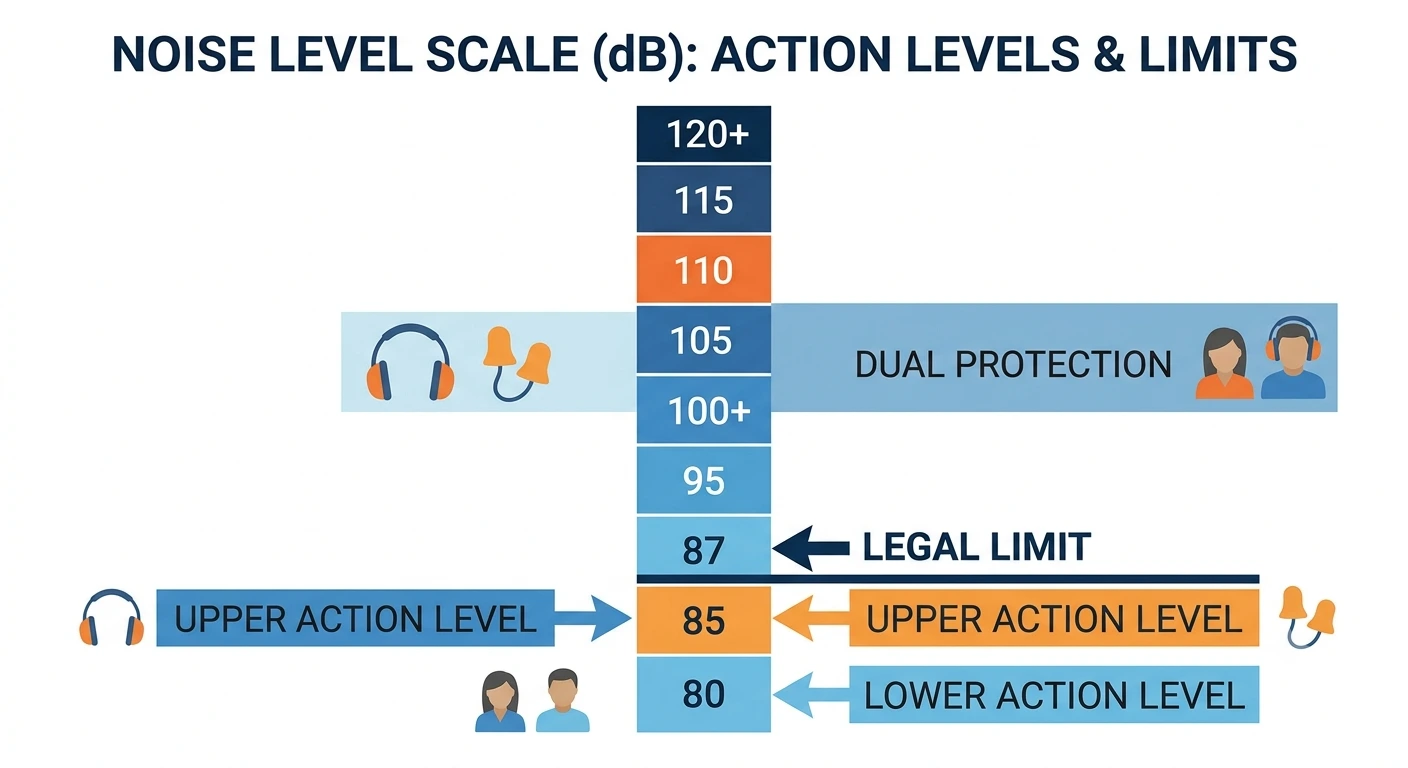
The Control of Noise at Work Regulations 2005 sets three numbers you need to know. At an average daily exposure of 80 dB(A), you must provide hearing protection on request and give workers information and training. At 85 dB(A), protection becomes compulsory. You have to make sure it's worn, and you should mark hearing protection zones. At 87 dB(A), that's the legal limit, measured with protection in place. Go above it and you're breaking the law.
For context, a site with a compressor running, a circular saw, or a breaker going is comfortably above 85 dB(A). So for most construction teams this isn't optional. The question isn't whether your workers need protection, it's which kind actually gets worn.
Earplug vs earmuff: how to read the ratings
Every hearing protector sold in Europe is tested to the EN 352 series. EN 352-1 covers earmuffs, EN 352-2 covers earplugs. The figure you'll see on the packaging is the SNR, the single number rating. It's one number, in decibels, for how much noise the protector takes off in lab conditions.
A decent foam earplug runs from about 31 to 37 dB SNR. The 3M Classic sits at 31 dB, the E-A-Rsoft Yellow Neons at 36 dB. A good earmuff is in the same ballpark: the 3M Peltor Optime III is rated at 35 dB SNR.
Here's the catch. Those numbers come from a perfect fit in a test lab. In the real world you get less, sometimes a lot less. A plug that isn't rolled properly, isn't pushed in deep enough, or is taken out for ten minutes delivers a fraction of its rated protection. That's why the law cares about average daily exposure, not just peak noise.
When earplugs are the better choice

Earplugs have three practical advantages: they're cheap in bulk, they work alongside everything else you're wearing, and they don't get hot.
If your team wears hard hats and safety glasses all day, plugs are usually the path of least resistance. No headband fighting with a helmet rim, no pressure points, no sweat traps on a hot roof or near a furnace. A 200-pair box of Bell Comfort foam plugs costs about £30, roughly what one pair of Peltor Optime III muffs goes for. When you're kitting out a whole site, that maths matters.
The downsides are real. Foam plugs only work if they're fitted properly. Roll the plug into a thin cylinder, pull the top of your ear up and back, insert it, and hold it there while the foam expands. Most people skip half those steps, and the protection drops with every skipped step. That's why we sell a lot of corded plugs; when one falls out on site, you're not losing it in the mud. And if you go reusable, each worker needs their own pair. Ear infections from shared plugs are a thing.
When earmuffs are the better choice
Earmuffs are more forgiving. You put them on, they sit over your ears, done. No fitting skill required. That makes them a strong option for visitors, for contractors who only spend an hour in the noisy area, and for anyone who won't roll a plug properly no matter how many times you show them.
They're also visible. A site manager can see at a glance whether someone is wearing muffs. You can't see a plug that's half out of someone's ear. And in intermittent noise, where workers are in and out of a loud area all day, muffs are easier to take on and off than plugs you have to re-roll every time.
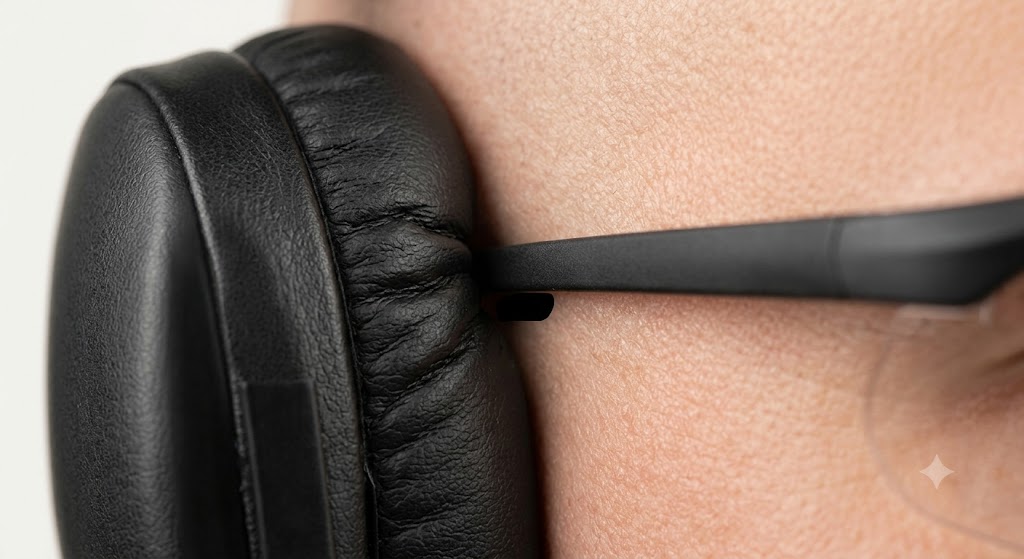
The trade-offs: they're bulky, they get hot, and they press on your head. With a hard hat you need either a helmet-mounted set, which is tested to EN 352-3, or a low-profile headband that fits under the shell. Safety glasses are the classic problem. The arms break the seal between cushion and skin, and every break in the seal is a leak. If your team wears prescription glasses, test the combination before you buy in bulk.
When you need both
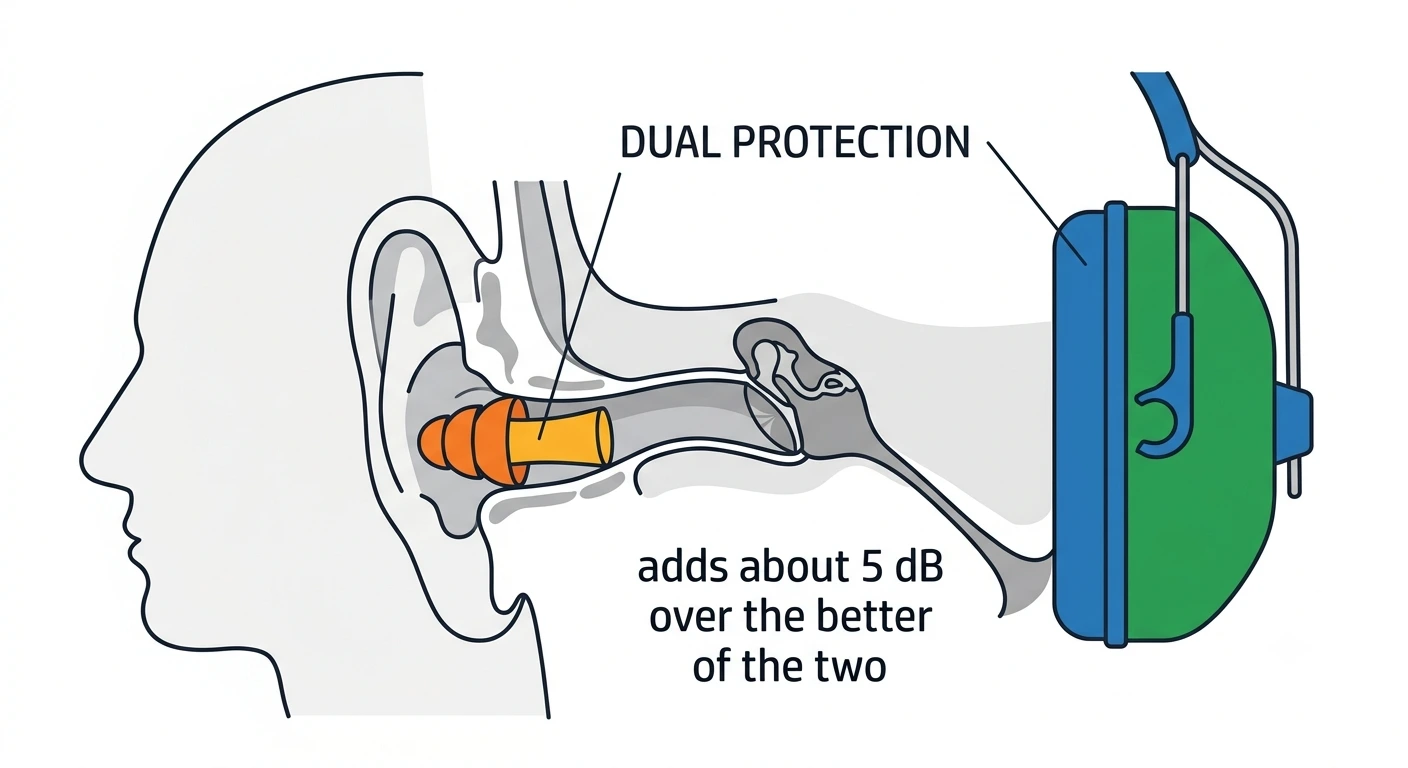
If noise sits above roughly 100 dB(A), or your risk assessment shows a single protector won't bring exposure under the 87 dB(A) limit, you need dual protection. Plugs under muffs.
Don't add the two ratings together. A 35 dB muff over a 36 dB plug does not give you 71 dB of protection. The practical rule is you get about 5 dB more than the better of the two. You're buying redundancy, not a sum.
There's also such a thing as too much protection. If workers can't hear a reversing alarm, a shout from the banksman, or a forklift approaching because they're over-protected, you've created a new hazard. HSE guidance is to aim for somewhere around 70 to 80 dB(A) at the ear. On a modest noise level, 37 dB plugs can isolate your team. Sometimes the right answer is a lower-rated protector, not a bigger one.
What we tell customers at Colbrook
Most teams we kit out end up with a mix. Foam plugs for the people doing hot, physical work in helmets all day. Muffs, often helmet-mounted, for the ones moving in and out of loud zones. And a stock of spares, because somebody always loses theirs on a Monday morning.
We stock 3M Peltor muffs from the Optime range, Beeswift defenders for budget kits, and 3M and Bell foam plugs by the box, including corded versions and dispensers for sites that get through hundreds of pairs a year. If you're not sure where to start, look at your noise risk assessment first. That tells you the levels. Then think about what else your team wears, how hot the work is, and how long they're actually in the noise. That's most of the decision made.
For more on how the EN 352 standard works and how to read SNR ratings properly, we covered it in our guide to EN 352 hearing protection standards.
Browse our hearing protection range for earplugs, earmuffs, and helmet-mounted options, or call us on +44(0)1236 755544 and we'll help you match the protection to the job.

REF: earplug-vs-earmuff