
Noise-induced hearing loss is permanent, preventable, and one of the most common workplace injuries in the UK. Once the damage is done, there's no coming back. That's why EN 352 exists — it's the standard that governs all hearing protectors used at work, from simple foam earplugs to electronic communication earmuffs.
The Control of Noise at Work Regulations 2005 sets the action levels: 80 dB is the lower action level (provide information and hearing protection on request) and 85 dB is the upper action level (compulsory to provide and enforce use).
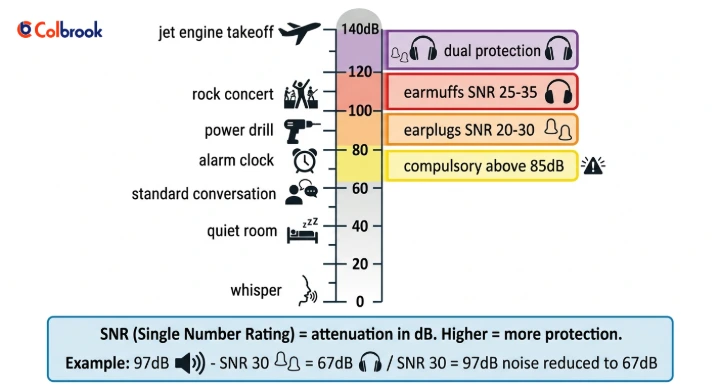
SNR — The Number That Matters
Every EN 352 product carries an SNR (Single Number Rating). It tells you how many decibels the protector reduces the noise by. Simple stuff:
- Noise level at your ear = 97 dB
- SNR of your earplug = 30
- Level reaching your ear = 97 − 30 = 67 dB
A few things to keep in mind. The SNR is measured in lab conditions — real-world attenuation is usually lower (about half the SNR value is a safer estimate). And over-protecting is a problem too: if you cut noise to below 70 dB, you isolate the wearer from warning shouts and machine sounds, which creates its own safety risk.
How Much SNR Do You Need?
| Noise Level | Example | SNR Needed |
|---|---|---|
| 80-85 dB | Busy office, light machinery | 20-25 (earplugs) |
| 85-100 dB | Construction site, factory floor | 25-30 (earplugs or earmuffs) |
| 100-120 dB | Chainsaw, pneumatic drill, heavy plant | 30-35 (earmuffs) |
| 120+ dB | Jet engine test, riveting, gunfire | 35+ (dual protection — plugs + muffs) |
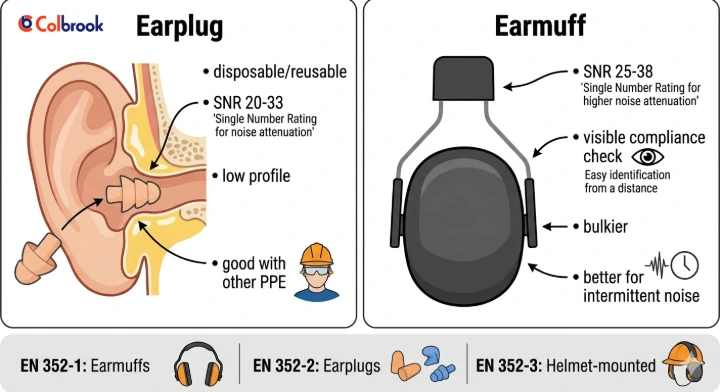
EN 352 by Product Type
EN 352-1: Earmuffs
Headband or helmet-mounted cups that seal around the ear. Good for intermittent noise (easy to take on and off) and visible compliance checks — you can see someone's wearing them. Bulkier than plugs, can get hot in summer, and hard to wear with other PPE like hard hats or respirators if not compatible.
EN 352-2: Earplugs
Inserted into the ear canal. Available as disposable foam, reusable silicone, or custom-moulded. Low profile, works with other PPE, good for hot environments. But they're easy to fit poorly — and a badly fitted plug gives almost no protection.
Key distinction: roll-down foam plugs need to be rolled into a thin cylinder, inserted, and held while they expand. Pre-formed banded plugs are pushed in and ready to go. Training matters more than the type.
EN 352-3: Helmet-Mounted Earmuffs
Earmuffs designed to attach to a hard hat or industrial safety helmet. Must be compatible with the specific helmet model. Handy on sites where workers need hard hat and hearing protection together — no extra headband to deal with.
EN 352-4 to 352-10: Special Types
The standard also covers level-dependent muffs (amplify quiet sounds, block loud ones), electronic communication muffs (radio or Bluetooth), and passive noise-cancelling variants. These are increasingly common on active sites where teams need to communicate.
Selection Tips
- Below 85 dB: Earplugs are usually sufficient and more comfortable for all-day wear
- 85-100 dB: Either works — choose based on comfort, compatibility, and duration
- Above 100 dB: Earmuffs or dual protection. Don't rely on plugs alone
- Dual protection: Plugs + muffs together add about 5-10 dB extra attenuation, not the full sum
- Check the HML values: SNR is a single number. H (high frequency), M (medium), L (low) values give you more precision for specific noise spectra
Common Mistakes
- Wearing earplugs too loose — roll and insert properly or you're getting no protection
- Using earmuffs with long hair or thick glasses arms — the seal breaks and attenuation drops sharply
- Buying one type for everyone — fit varies by ear shape and head size. Offer options
- Not cleaning reusable plugs — they harbour bacteria and harden over time
- Thinking "single use" means "use ten times" — foam plugs degrade. Use fresh ones each shift
Browse Our Hearing Protection Range
We stock earplugs, earmuffs, and electronic hearing protectors from 3M, Portwest, and Moldex. Shop hearing protection or call +44(0)1236 755544 for advice.
This guide is for informational purposes. Always conduct a full risk assessment.