
PUWER Regulations Summary: What the Provision and Use of Work Equipment Regulations Mean for Your Site
If you've got anything on your site that plugs in, starts up, or gets switched on, PUWER applies. It's that simple.
The Provision and Use of Work Equipment Regulations 1998 (PUWER) is one of those pieces of health and safety law that covers almost every workplace in the UK. Yet plenty of site managers and business owners we talk to at Colbrook aren't sure exactly what it requires. They know it exists. They know it's important. But the detail gets fuzzy.
So here's the plain-English version. What PUWER actually says, who it applies to, and what you need to do to stay compliant.
What counts as work equipment under PUWER?
Broadly: anything you use to get a job done. A circular saw is work equipment. So is a forklift, a stepladder, a pressure washer, a welder, a bench grinder, even a handheld screwdriver. PUWER's definition is deliberately wide: "any machinery, appliance, apparatus, tool or installation for use at work."
That includes equipment your staff bring in themselves. So if a sparky turns up with their own crimping tool, that falls under PUWER too.
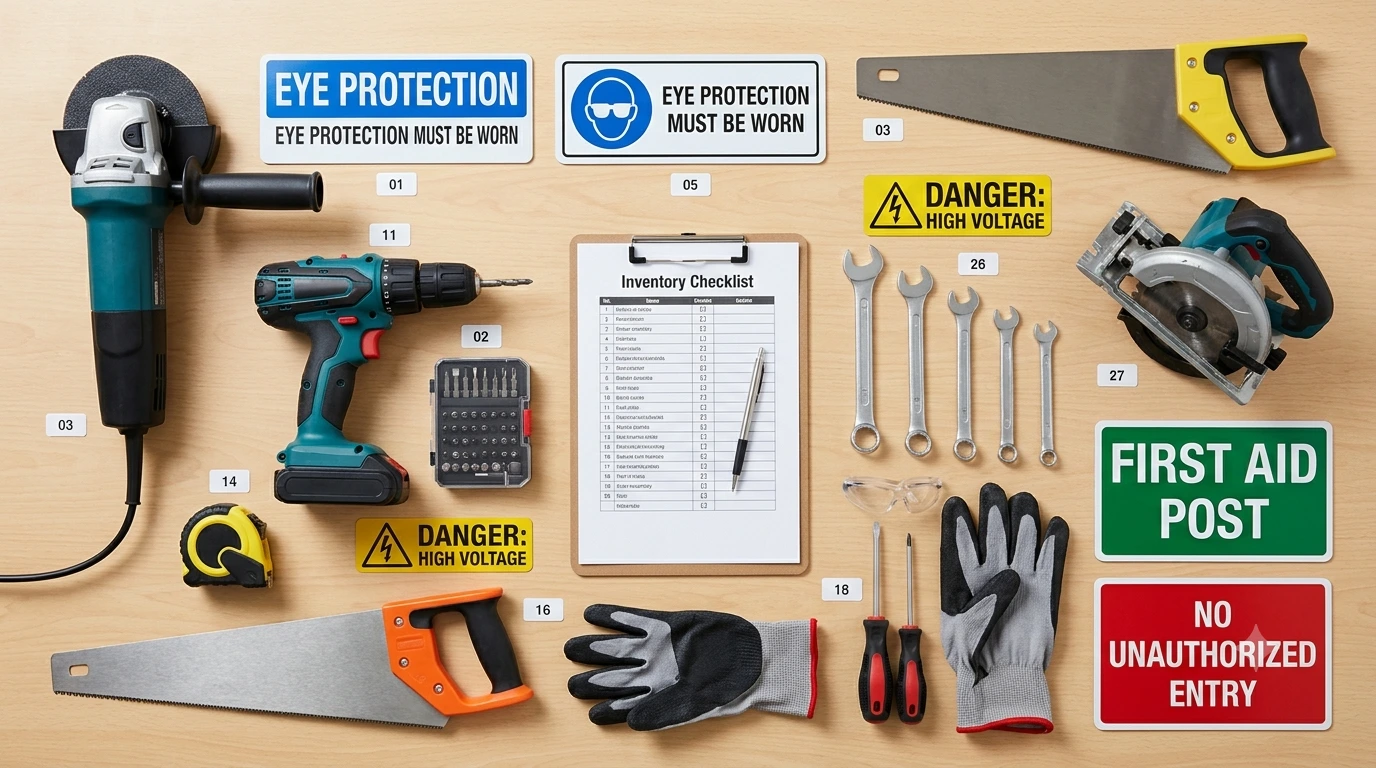
The regulations cover the whole lifecycle of using that equipment: starting it up, operating it, setting it up, transporting it, repairing it, maintaining it, servicing it, and cleaning it. If someone interacts with a piece of equipment as part of their job, PUWER has something to say about it.
The five key duties under PUWER
The regulations break down into five main areas. Here's what each one means in practice.
1. Suitability
Every piece of equipment has to be fit for the job you're using it for. You can't use a domestic-grade pressure washer on a commercial construction site and call it compliant. The equipment needs to be selected with the working conditions and actual risks in mind.
This sounds obvious, but we see it go wrong most often with hired or borrowed equipment. Someone brings in a machine they're not familiar with, for a task it wasn't designed for, and suddenly suitability is a real question.
2. Maintenance
Work equipment has to be maintained in an efficient state, in efficient working order, and in good repair. That doesn't always mean a full service schedule. For some tools it means a visual check before use. But if the equipment has a maintenance log, you need to keep it up to date.
Good practice is to have a maintenance regime based on the manufacturer's recommendations and the intensity of use. A forklift used three shifts a day needs more frequent attention than one used once a week.
3. Inspection
PUWER requires inspection in two specific situations. First, where safety depends on how equipment is installed, it needs inspecting after installation and before it's first used. Second, where equipment is exposed to conditions that could make it deteriorate and become dangerous, it needs regular inspection to catch faults before they cause harm.
Inspections need to be done by a competent person. That doesn't always mean an external engineer. For some equipment it could be a trained member of your team. But they need to know what they're looking for.
4. Information and training
Anyone using, supervising, or managing the use of work equipment needs adequate information, instruction, and training. This covers the correct use of the equipment, the risks that come with it, and the precautions to take.
Where the use of equipment involves a specific risk (woodworking machinery is the classic example), PUWER restricts use to people who've been specifically trained and appointed. You can't just let anyone loose on a table saw.
5. Dangerous parts and protective measures
This is the one most people think of when they hear "PUWER." You must take effective measures to prevent access to dangerous parts of machinery. Normally that means fixed guards. Where routine access is needed, interlocked guards may be required to stop dangerous movement before someone can reach the danger zone.
Where guarding isn't fully possible (a circular saw blade being the obvious example), the dangerous part must be protected as far as possible and a safe system of work put in place.
PUWER also requires emergency stop controls, means of isolating equipment from power sources, and measures to prevent risks from parts falling or being ejected.
What happens if you get it wrong?
HSE inspectors don't mess about with PUWER. They issue prohibition notices, improvement notices, and, in serious cases, prosecute. The HSE's website is clear that following the Approved Code of Practice (ACOP) for PUWER is not compulsory, but if you follow it, you'll normally be doing enough to comply. If you don't, you'd better have a good reason and an alternative that's at least as effective.
The ACOP has special legal status under section 16 of the Health and Safety at Work Act. Courts can refer to it when deciding whether you've met your duties. So ignoring it is risky.
PUWER doesn't sit in isolation
Other regulations apply alongside PUWER depending on the equipment. Lifting equipment must also meet LOLER (Lifting Operations and Lifting Equipment Regulations). Pressure equipment has its own set of rules. And personal protective equipment (the stuff we supply at Colbrook) falls under the PPE Regulations.
The point is: PUWER is rarely the only regulation in play. A full compliance picture means looking at the equipment, the task, the environment, and the person using it.
Practical steps for site managers
If you're responsible for a site and want to check your PUWER compliance, start with these four things:
1. **Inventory everything.** Make a list of every piece of work equipment on site. Include hired and borrowed kit.
2. **Check your training records.** Does everyone using that equipment have adequate training? Can you prove it?
3. **Review your inspection regime.** What gets inspected, how often, and by whom? Are the records in order?
4. **Look at your guards and safety devices.** Are they in place, in good condition, and fit for purpose?
It's not about paperwork for the sake of it. PUWER is built around a simple idea: equipment that's properly selected, maintained, and used by trained people is safer equipment. And safer equipment means fewer injuries.
At Colbrook, we supply PPE and workwear that helps keep your team safe. But the equipment they use matters just as much as what they wear. If you're unsure about your obligations, the HSE website is the place to start. Or give us a call on +44(0)1236 755544. We deal with safety every day and we're happy to point you in the right direction.