
EN ISO 374 Chemical Gloves Standards Explained: Types A, B & C
If you handle chemicals at work, the glove you pick matters more than most people think. The wrong pair won't just wear out faster. It can let the chemical straight through to your skin, and you won't notice until the damage is done.
EN ISO 374 is the standard that tells you what a chemical glove actually resists. Reading the label is easier than it looks once you know what the letters mean, and most chemical glove mistakes happen before the gloves even go on.
What EN ISO 374 covers
EN ISO 374 is the family of standards for protective gloves against dangerous chemicals and micro-organisms. The current version, EN ISO 374-1:2016, replaced the old EN 374-1:2003, and the two are quite different.
The 2016 update made things stricter. The list of test chemicals grew from 12 to 18, and gloves are now graded into three types: A, B and C. If a glove was certified under the old standard, treat its claims with care.
The standard has four parts that matter on a label. Part 1 covers permeation, chemicals passing through the material itself. Part 2 covers penetration, leaks through holes, pinholes and seams. Part 4 covers degradation, the material breaking down on contact. Part 5 covers protection against micro-organisms. The pictogram tells you which parts the glove passes.
Types A, B and C: what the label means
The type letter is the first thing to check. It tells you how much testing the glove has been through:
- Type A means at least 30 minutes of breakthrough time against 6 or more of the 18 test chemicals.
- Type B means at least 30 minutes against 3 to 5 chemicals.
- Type C means at least 10 minutes against at least 1 chemical, splash protection at best.
Below the type letter come the chemical codes, one letter for each of the 18 standard test chemicals. A is methanol, B is acetone, F is toluene, K is 40% sodium hydroxide, L is 96% sulphuric acid. If the label shows a letter, the glove passed against that chemical.
A real example. Our Portwest Chem 320 nitrile gauntlet carries EN ISO 374-1 Type A with the codes AJKLMNOT: eight chemicals passed at level 2 or better, including methanol, n-heptane, caustic soda and sulphuric acid. That's a properly protective glove, and it costs £2.55.
The three ways a chemical gets through
Chemical gloves fail in three different ways, and the standard tests for all of them.
Permeation is the sneaky one. The chemical dissolves into the glove material at a molecular level, works its way through, and appears on your skin. No holes, no visible damage. Breakthrough time is how long that takes, graded from level 1 (over 10 minutes) up to level 6 (over 480 minutes). The Type A and B ratings are built on the 30-minute mark, level 2.
Penetration is simpler: the chemical gets through a hole or a bad seam. The standard tests this with air and water leakage and rates the result by acceptable quality level, or AQL. A lower AQL number means fewer leaks allowed per batch.
Degradation is what happens to the glove itself. The material swells, hardens, cracks or dissolves, even when nothing has leaked through yet. A glove can fail by degradation long before its breakthrough time is up.
One practical note. Lab tests run at 23 degrees with the glove in constant contact with a single chemical. Real work is messier: hotter, mixed chemicals, friction, stretching. Treat the rated time as a ceiling, not a promise. A common rule of thumb is to use a glove for no more than half its rated breakthrough time before swapping it.
Match the glove to the chemical
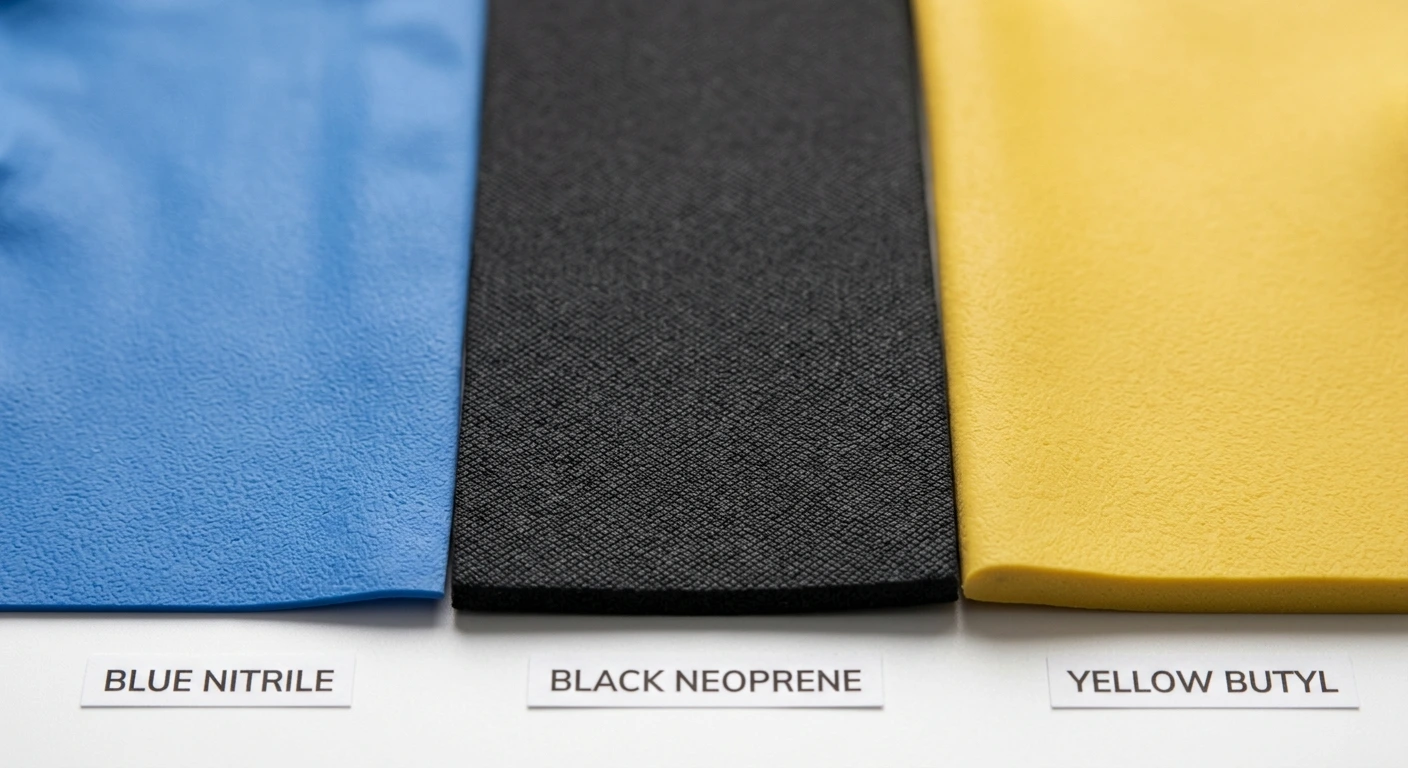
No single material blocks everything. Nitrile is the all-rounder: strong against oils, greases and many acids and caustics, but poor against ketones like acetone. Neoprene handles acids, bases and alcohols well. Butyl is the choice for ketones, esters and gases. Natural latex suits water-based chemicals and dilute acids, but not oils or solvents.
So the first step is reading the safety data sheet for the product you're actually using. Find the chemical, check the codes on the glove label, and only buy when there's a match. If your team is cleaning with a solvent-based degreaser, a standard nitrile gauntlet might be the wrong tool entirely.
And don't forget the physical side. Chemical gloves still need to stand up to the job. Check the EN 388 ratings for cut and abrasion, covered in our leather gloves guide, plus EN 420 for dexterity. A chemical glove that's too stiff to grip properly gets taken off, and an unused glove protects nobody.
Disposable gloves are not chemical gloves
This is the mistake we see most often. A box of blue nitrile disposables gets handed out for "chemical" work, and everyone assumes they're protected.
Those gloves are tested for micro-organisms and splash protection, usually to EN ISO 374-5, and they're fine for light cleaning, contamination control and food handling. They are not designed for immersion in solvents, acids or degreasers. Their breakthrough times against most chemicals are minutes, not hours.
If the job involves dipping, pouring or spraying concentrated chemicals, you need a reusable gauntlet tested to EN ISO 374-1. Disposables have their place. It's just not there.
Care, checking and replacement
Reusable chemical gauntlets need a bit of looking after. Rinse them after use, dry them properly, and inspect them before every shift. Look for swelling, cracking, discolouration or stiffness: all signs the material is degrading, even when the glove still looks usable.
Replace a gauntlet after any significant chemical exposure. Don't wait for visible damage. Store gloves away from sunlight, heat and ozone sources. A glove left on a sunny windowsill ages faster than one kept in a drawer.
The right glove for the job
The label tells you what a glove is genuinely rated for. Type letter, chemical codes, parts of the standard passed: that's the whole story in one glance.
We stock the full Portwest Chem range, from the £2.55 Chem 320 nitrile gauntlet up to butyl and neoprene options for the nastier chemicals, plus the rest of our PPE range. If you're not sure what your chemicals need, call us on +44(0)1236 755544 and talk it through with a human. We'd rather sell you the right glove than the cheap one.
REF: en-iso-374-chemical-gloves-standards-explained