
Burns are one of the most painful and debilitating workplace injuries. Every year in the UK, thousands of workers suffer hand burns from contact with hot surfaces, flames, molten metal, and radiant heat. The right gloves can prevent these injuries, but only if you know what you're looking at.
That's where EN 407:2020 comes in. It's the European standard for protective gloves against thermal risks (heat and/or fire). If you buy heat-resistant gloves in the UK, you'll see the EN 407 pictogram on the label, along with a row of performance numbers. This article explains what those numbers mean and how to use them.
What Is EN 407?
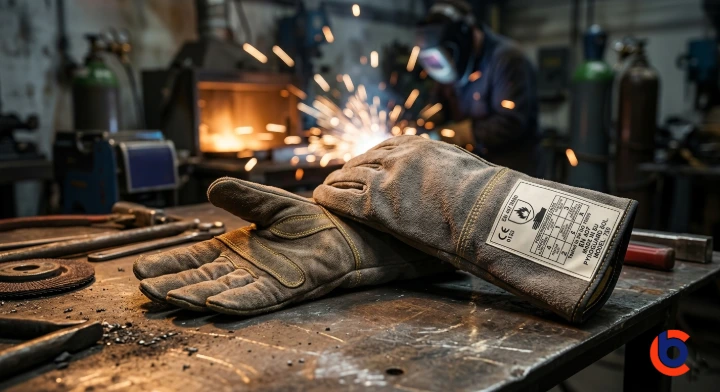
EN 407 is the European standard that specifies the test methods, performance requirements, and marking for gloves that protect against heat and fire. It's adopted as BS EN 407 in the UK. The standard was updated in 2020, and the current version is EN 407:2020.
The standard covers six different types of thermal hazard. Each one gets a performance level from 0 to 4 (or 0 to 3 for one test), where 0 means not tested or not applicable, and the highest number means the best protection. These levels are displayed in a grid on the glove label, always in the same order.
The Six Performance Levels Explained
The EN 407 pictogram shows a flame over an open hand, followed by six numbers arranged in two rows of three. Reading left to right, top to bottom, this is what they mean.
A: Limited Flame Spread (Levels 0-4)
This test measures how the glove material behaves when exposed to a flame. The glove is held in a gas flame for a specific time, then removed. The test measures:
- Afterflame time — how long the material continues burning after the flame source is removed
- Afterglow time — how long it continues to glow
Level 4 (the highest) requires: afterflame time less than 2 seconds, afterglow time less than 2 seconds, and no hole formation. Level 1 allows up to 15 seconds of afterflame. If the glove isn't tested for flame resistance, the rating is X (not 0).
Important: A glove with A-level 4 isn't fire-proof. It means the material self-extinguishes. Leather gloves, for example, typically score well here. Cotton gloves treated with flame retardant also perform well. Synthetic materials vary widely.
B: Contact Heat (Levels 0-4)
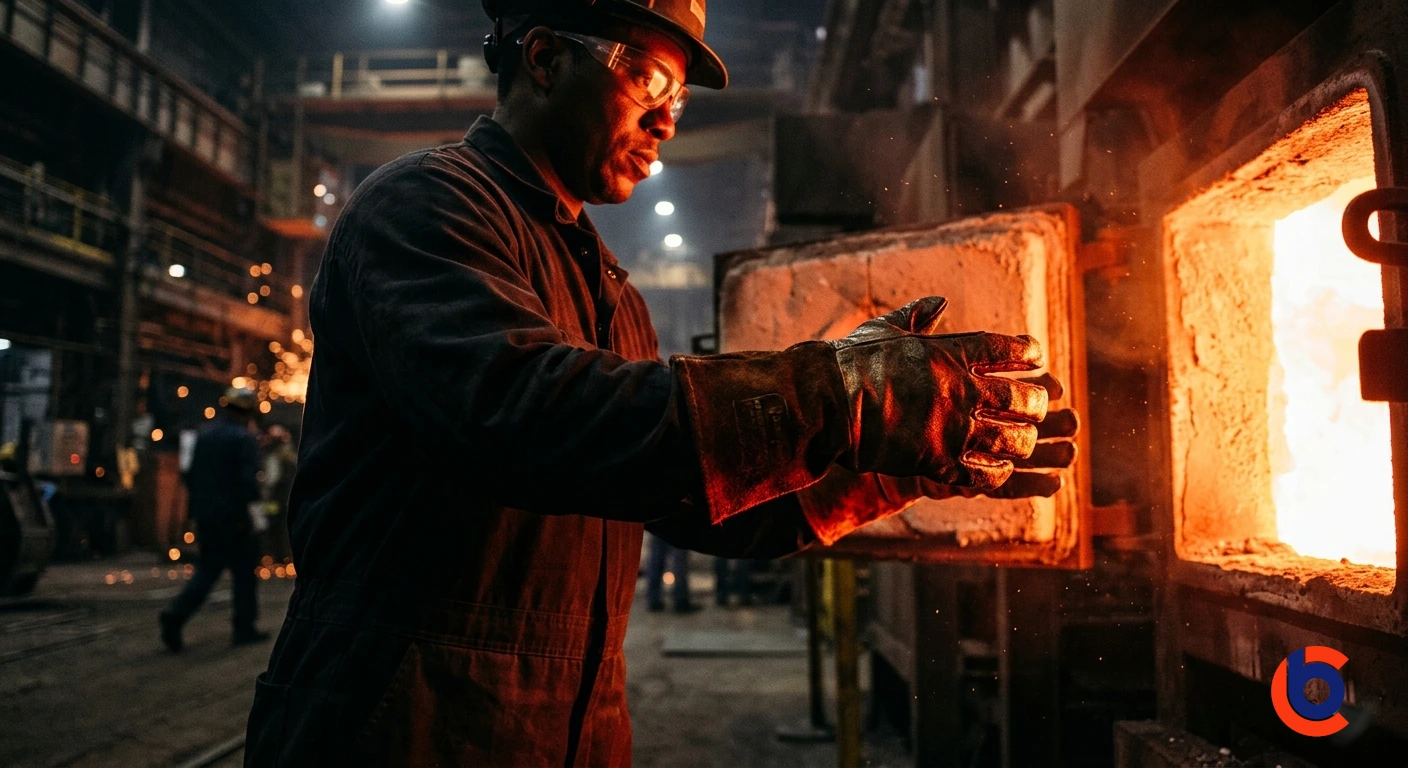
This test measures the glove's ability to protect against contact with hot surfaces. The glove material is placed against a heated plate at a set temperature for a specific time. The test measures the temperature rise on the inside of the glove.
| Level | Contact Temperature | Threshold Time (min) |
|---|---|---|
| 1 | 100°C | 15 seconds |
| 2 | 250°C | 15 seconds |
| 3 | 350°C | 15 seconds |
| 4 | 500°C | 15 seconds |
This is the most practical test for most workplaces. If you handle hot pipes, weld spatter, or heated machinery parts, the Contact Heat rating tells you how hot a surface you can safely touch. Level 4 means the glove can handle 500°C surfaces for at least 15 seconds without the inside temperature rising dangerously.
Threshold time matters. A glove rated Level 4 at 500°C allows only 15 seconds of contact. Longer contact can still cause burns. Never treat a high rating as a licence to hold hot objects indefinitely.
C: Convective Heat (Levels 0-4)
This test measures protection against flames or hot gases. The glove is exposed to a calibrated burner flame with a heat flux of 80 kW/m². The test measures how long it takes for the temperature on the inside of the glove to rise by 24°C.
| Level | Minimum Time to 24°C Rise |
|---|---|
| 1 | 4 seconds |
| 2 | 7 seconds |
| 3 | 10 seconds |
| 4 | 18 seconds |
Convective heat protection matters for firefighters, welders, and anyone working near flames. Higher levels give you more time to react and get clear of the heat source.
D: Radiant Heat (Levels 0-4)
Radiant heat comes from hot surfaces without direct contact — standing near a furnace or a welding arc, for example. The test exposes the glove to a radiant heat source at 20 kW/m². The measurement is the time for the inside temperature to rise by 24°C.
| Level | Minimum Time to 24°C Rise |
|---|---|
| 1 | 7 seconds |
| 2 | 20 seconds |
| 3 | 50 seconds |
| 4 | 95 seconds |
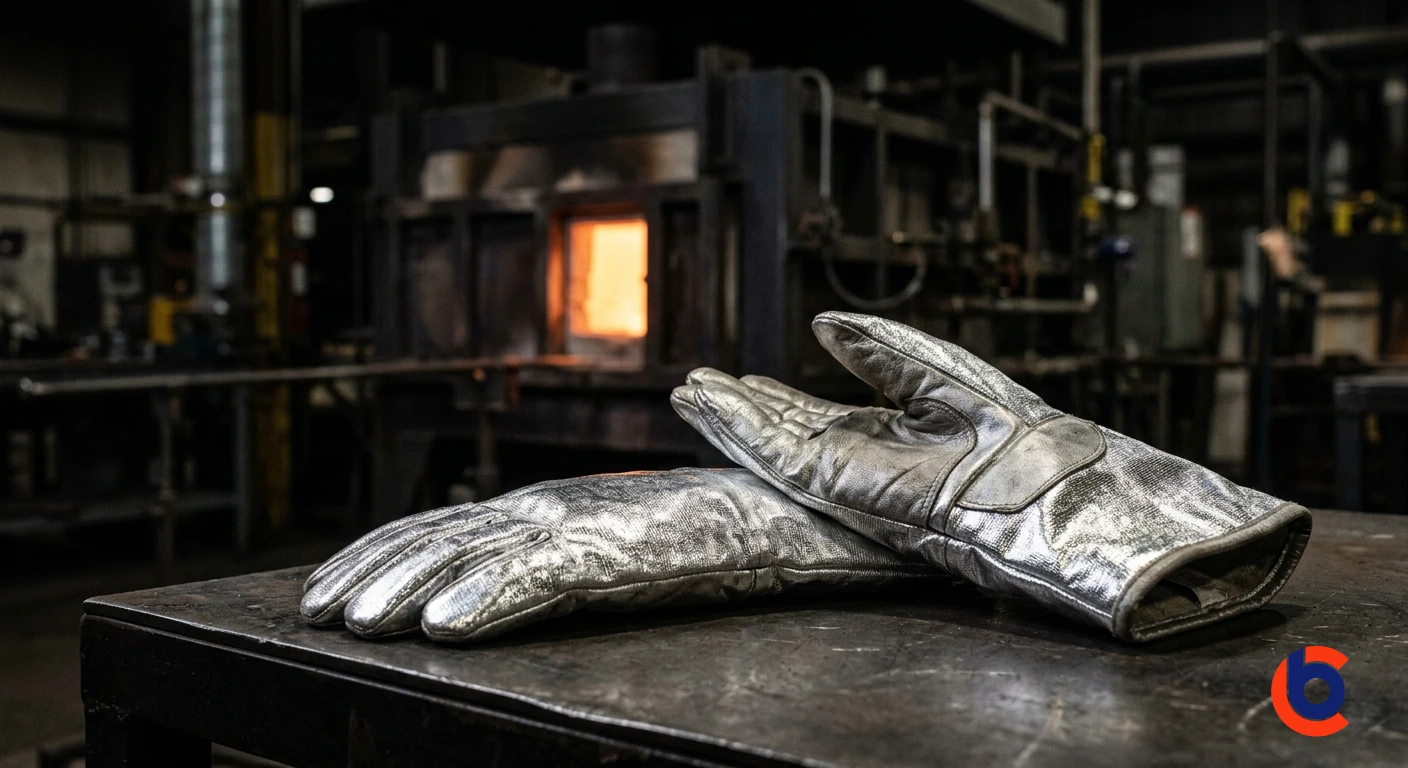
Aluminised gloves, which reflect radiant heat, typically achieve the highest levels here. Leather and Kevlar gloves can also perform well depending on construction. If you work near furnaces, kilns, or hot process equipment, this is a critical rating to check.
E: Small Molten Metal Splash (Levels 0-4)
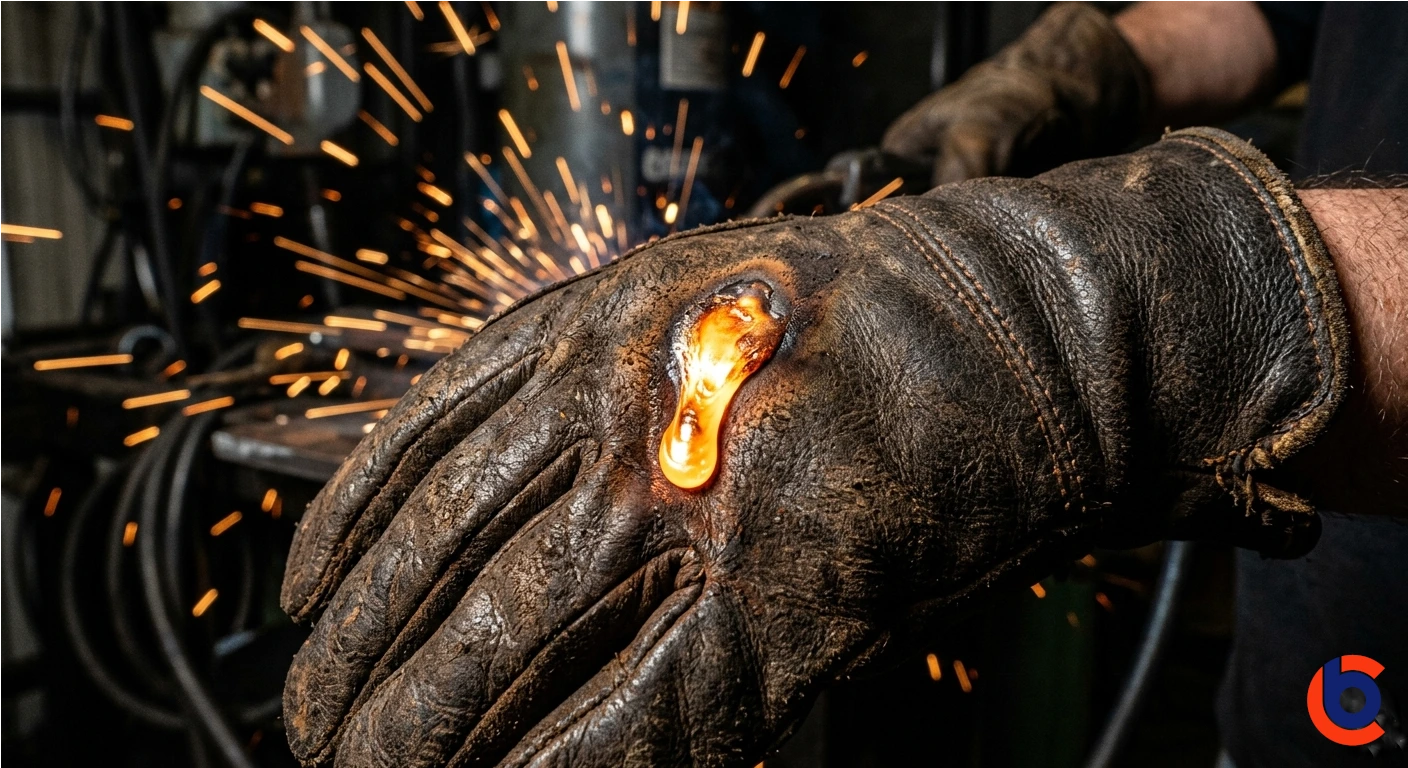
This test simulates the protection against small splashes of molten metal. The glove is positioned at a 60° angle, and molten steel is poured over it. The test measures how many grams of molten metal it takes to raise the inside temperature by 40°C, or for molten metal to stick to the glove.
| Level | Minimum Grams of Molten Metal |
|---|---|
| 1 | 30 g |
| 2 | 60 g |
| 3 | 100 g |
| 4 | 120 g |
This test matters for welders and foundry workers. Gloves with a high E rating have smooth outer surfaces that let molten metal run off rather than sticking and burning through. Grain split leather and specialist aluminised fabrics perform best here.
F: Large Molten Iron Splash (Levels 0-3)
This test is similar to E but uses molten iron (higher temperature than steel) in larger volumes. The ratings are levels 1 to 3, and the performance requirements are measured by the number of grams required to cause a 40°C temperature rise on the inside.
| Level | Minimum Grams of Molten Iron |
|---|---|
| 1 | 60 g |
| 2 | 120 g |
| 3 | 200 g |
This is the toughest test. Only gloves designed specifically for foundry or molten-metal work typically achieve Level 3 in the F test. Most welding gloves score lower or are not tested (X).
How to Read an EN 407 Label
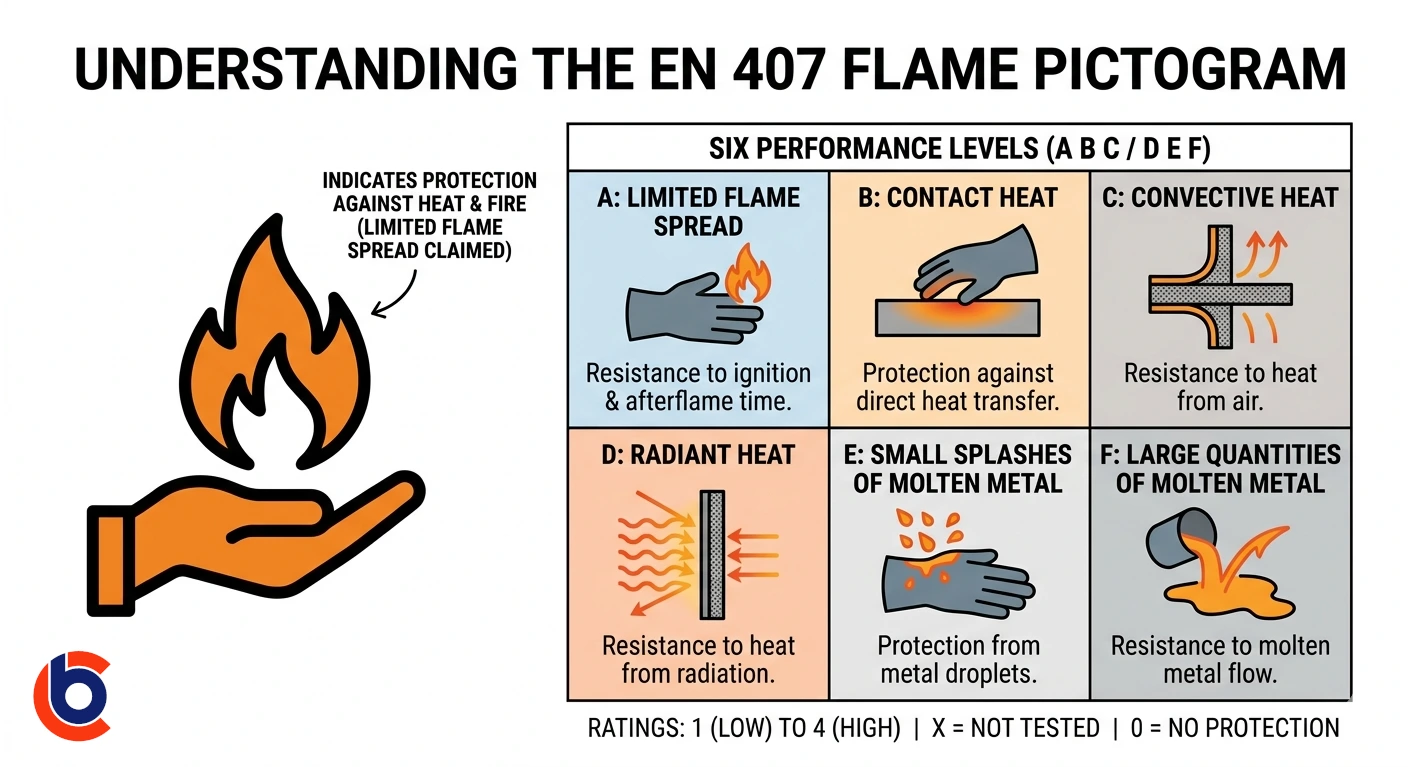
An EN 407 glove label shows the pictogram followed by six characters in a two-by-three grid. For example:
A B C
D E F
If you see: 4 X 2 X 3 X
That means: Limited flame spread Level 4, contact heat not tested, convective heat Level 2, radiant heat not tested, molten metal splash Level 3, molten iron splash not tested.
Always check all six ratings before selecting a glove. A glove that's excellent for contact heat (B4) might offer no protection against molten metal splash (EX). Match the glove to the specific hazard you face, not the highest single number.
Choosing the Right EN 407 Gloves
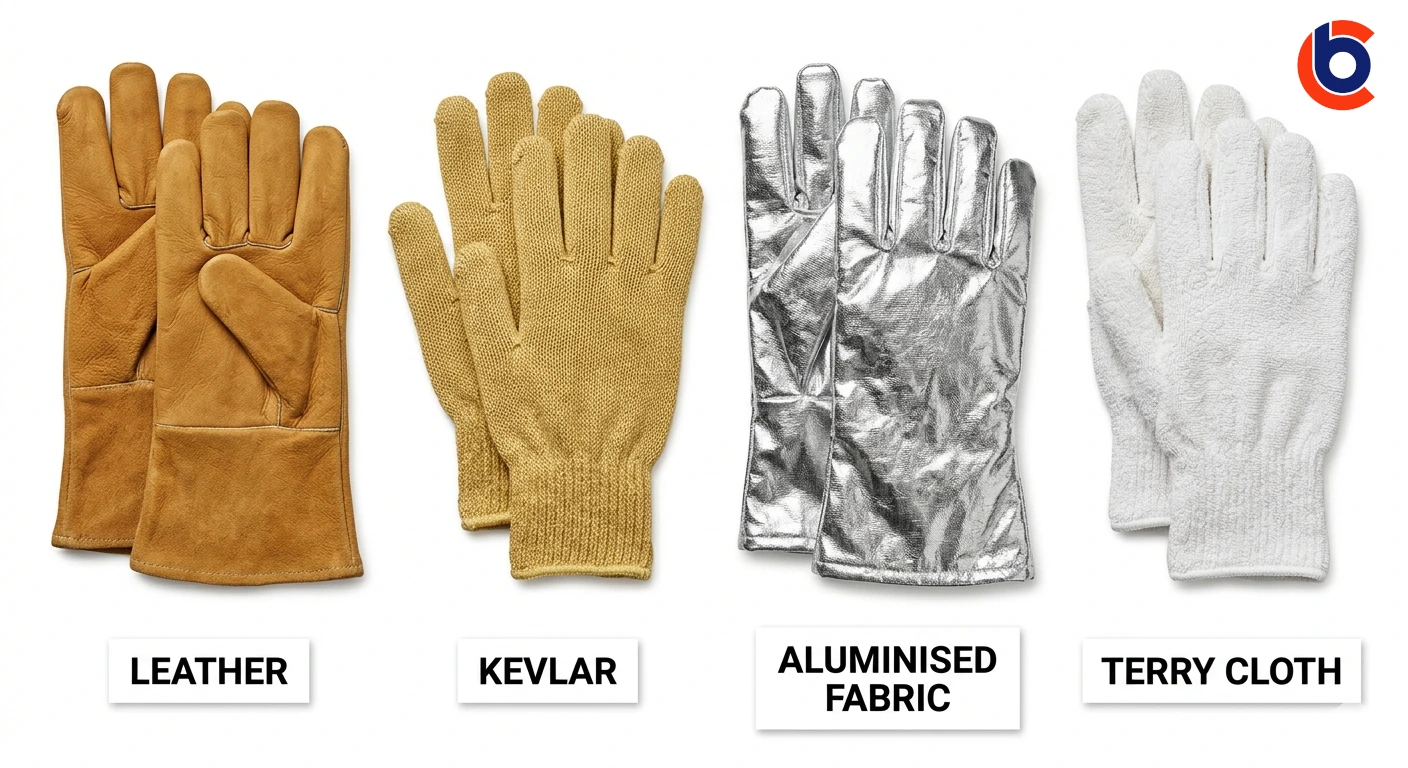
Selection depends on the specific thermal risks in your workplace. Here's a quick guide:
- Welding gloves — look for A3/A4 (flame spread), B2/B3 (contact heat), and E2+ (molten metal splash). Pigskin or cowhide leather gloves with Kevlar stitching are the standard choice.
- Foundry/steelwork gloves — look for A4, B4, E4, F3. Aluminised backing or heavy grain split leather required.
- Kitchen/oven gloves — B2/B3 is sufficient (contact heat up to 350°C). A and E ratings usually not relevant (X).
- Firefighter gloves — A4, C4 (convective heat), and D3+ (radiant heat) are essential. Multilayer construction with moisture barrier.
- Furnace/kiln work — prioritise D (radiant heat) and B (contact heat). Long cuffs for forearm protection.

Compatibility With Other Standards
EN 407 is often combined with EN 388 (mechanical protection) on the same glove. A welding glove might carry EN 388 for cut and abrasion resistance alongside EN 407 for thermal protection. Check both ratings to make sure the glove is mechanically tough enough for the job as well as heat-resistant.
For gloves that also offer chemical protection, check EN 374. EN 407 doesn't cover chemical resistance, even though some heat-protective gloves use chemical-resistant coatings.
Care and Replacement
Heat-protective gloves degrade over time. Heat exposure itself damages the fibres and leather, reducing the effective protection level. Replace gloves if you notice:
- Hardening or cracking of leather or fabric
- Shrinking after exposure to heat
- Burns, scorch marks, or holes
- Loss of flexibility or dexterity
- Damaged or frayed stitching
Store heat-resistant gloves in a cool, dry place away from direct sunlight, heat sources, and chemicals. UV radiation and ozone degrade many glove materials over time.
Summary
EN 407 is the standard you need to understand when buying heat-protective gloves. The six-number performance grid tells you exactly how the glove performs against flame, contact heat, convective heat, radiant heat, and molten metal splash. Read all six numbers, not just the highest one, and match the glove to the specific hazard in your workplace.
Need heat-resistant gloves for your team?
Browse our range of heat protection and welding gloves
REF: en-407-heat-gloves
Phone: +44(0)1236 755544