
Not all gloves are created equal. The standard EN 388 is the European benchmark for protective gloves against mechanical risks — abrasion, cutting, tearing, and puncture.
Understanding the 4-digit code on your glove label means you can choose the right protection for the job.
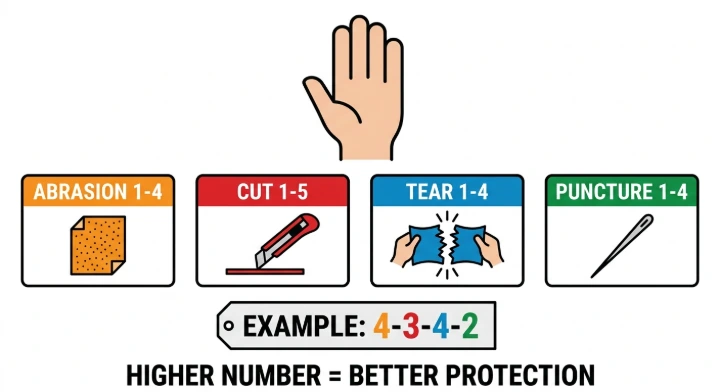
The EN 388 4-Digit Code
EN 388 ratings are displayed as a 4-digit code, e.g. 4-3-4-2. Each digit represents a different test:
| Position | Test | Scale | How It's Tested |
|---|---|---|---|
| 1st | Abrasion resistance | 1–4 | Cycles on sandpaper before wear-through |
| 2nd | Blade cut resistance | 1–5 | Cycles of a circular blade to cut through |
| 3rd | Tear resistance | 1–4 | Force required to tear the material |
| 4th | Puncture resistance | 1–4 | Force required to penetrate with a standard stylus |
Higher number = better protection. A glove rated 4-3-4-2 offers excellent abrasion and tear resistance, good cut resistance, and moderate puncture protection.
New EN 388:2016 — The 5th Digit
A 2016 update added a 5th character for advanced cut tests:
- A to F — coupe test (straight blade, EN ISO 13997)
- T — only if the original cut test (2nd digit) was replaced by the coupe test
- X — test not applicable
So a modern label might read 4X43F where X means the blade cut test wasn't performed (cut tested via coupe method instead, rated F).
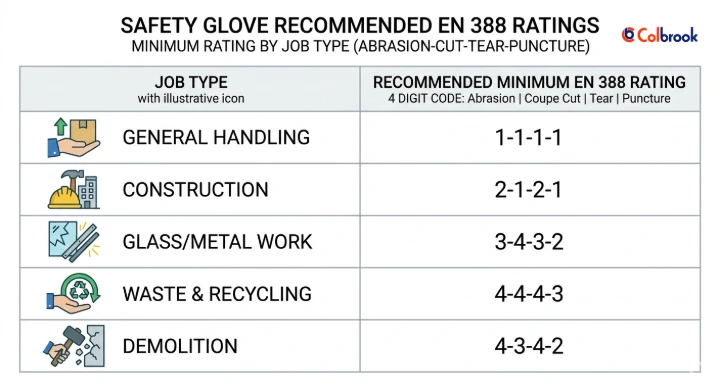
Which Glove for Which Job?
| Job Type | Minimum Rating | Glove Type |
|---|---|---|
| General handling / light assembly | 1-1-1-1 | Lightweight nylon or cotton |
| Construction / block work | 2-1-2-1 | General purpose latex-coated |
| Glass handling / metal work | 3-4-3-2 | Kevlar or HPPE cut-resistant |
| Waste & recycling | 4-4-4-3 | Heavy-duty leather or nitrile-coated |
| Demolition / heavy construction | 4-3-4-2 | Full leather or reinforced synthetic |
Other Glove Standards
| Standard | Protection Type |
|---|---|
| EN 374 | Chemical & microbiological protection |
| EN 407 | Thermal / heat protection |
| EN 511 | Cold protection |
| EN 12477 | Welder's gloves |
| EN 60903 | Electrical insulation |
Washing and Care
Gloves lose performance over time. Replace when:
- Visible wear, holes, or thinning
- Loss of grip or coating peeling
- After contact with hazardous chemicals (disposable)
- If they no longer pass visual inspection
Common Mistakes
- Using a cut-resistant glove for chemical handling — they're not the same
- Wearing gloves that are too large — reduces dexterity and grip
- Ignoring the 5th character (A-F) on newer labels
- Re-using disposable gloves meant for single use
Browse Our Glove Range
We stock gloves for every risk level — from lightweight handling to high-cut glass handling and chemical-resistant gauntlets. Shop all gloves or call +44(0)1236 755544.
This guide is for informational purposes. Always conduct a full risk assessment and consult the HSE for your specific workplace requirements.