
Every January we get the same call. A customer has a team working in a freezer at -22°C, or on a yard in Airdrie with the wind coming off the hills, and last year's jackets are not cutting it. Nine times out of ten they have no EN 342 claim on them at all. They are ordinary padded work jackets with a warm looking lining, and the label says nothing about how cold they can handle.
EN 342 answers that question. It sets out how much insulation a garment provides, how wind resistant it is, and whether it has been tested against water penetration.
Where EN 342 applies, and what it leaves out
EN 342:2017 covers garments and ensembles for protection against cold environments at or below -5°C. That is the dividing line worth remembering. Above it, the relevant standard is EN 14058, which deals with cool environments where wind chill is the main problem rather than sustained low temperature.
The test is straightforward in principle. A full size manikin wired with thermal sensors is dressed in the garment, or in the jacket and trouser combination, then put into a climate chamber and made to walk. The result is the Icler value, the effective thermal insulation, measured in m²·K/W. Because the manikin is moving, the figure reflects real wear rather than how thick the padding feels on a rail.
Coveralls can only be assessed under EN 342, and jacket and trouser sets are assessed as an ensemble. Single garments can be tested, but they get combined with standardised reference clothing, so a jacket tested on its own is not the same claim as a full suit tested together.
What the three values after the pictogram mean
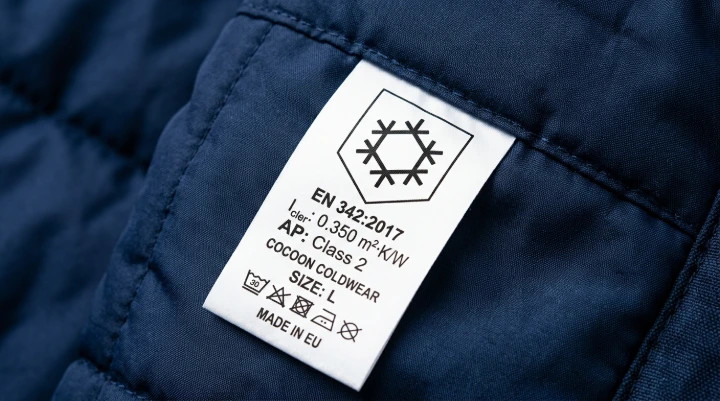
Cold protection garments carry a snowflake pictogram with a code underneath it. Most buyers ignore the code. It is the most useful thing on the label.
First is Icler, the insulation figure. The higher it goes, the longer your team can work before the cold gets into them. Figures on the market run from roughly 0.170 up to 0.620 m²·K/W.
Second is air permeability, or AP, graded 1 to 3. Class 3 is the most wind resistant. On an exposed Scottish site this is often what decides whether a jacket works, because wind strips away the layer of warm air your body is trying to keep around itself. A garment with good Icler and poor AP feels useless in a crosswind.
Third is water penetration. That one is optional. If the garment has been tested you get a class, and if not you will see an X in that position. EN 342 only records whether the test was done. The full rain classification is EN 343, and plenty of cold weather gear carries both.
How long someone can work in a garment depends on Icler and how hard they are working. At an Icler of 0.310 m²·K/W, light work is comfortable for an eight hour shift down to about -1°C, and for roughly an hour at -15°C. The same insulation at medium activity pushes the eight hour figure to about -19°C, because the body generates its own heat. At 0.390 the eight hour light work figure is around -8°C.
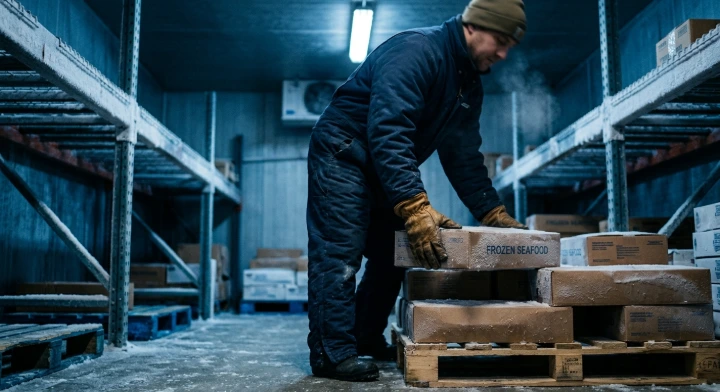
Which is why "what do I need for a -20°C cold store" has no single answer. It depends whether the team is standing at a packing station or moving pallets all shift.
The layers matter more than the jacket
Cold store clothing works as a system. A base layer moves sweat away from the skin, a mid layer traps warm air, and the outer garment blocks wind and cold. Get the base layer wrong and everything else underperforms, because a wet wearer loses heat far faster than a dry one no matter how much insulation is wrapped around them.
We stock JCB Workwear base layer tops and pants at £12.62 each, or the unisex set at £32.98. Regatta's Pro base layer top is £13.95. For a mid layer, a heavy fleece such as the Argyll F400 at £21.50 does the job under a cold store jacket and costs a lot less than a heavier outer bought to compensate. Our base layer range has the full choice.
The hat matters as well. A cold store helmet with a thermal lining, like the H33 at £27.50, does more for comfort through a shift than an extra layer on the torso.
Head, hands and feet sit under separate standards
EN 342 does not apply to headwear, handwear or footwear, which catches people out. Cold work gloves sit under EN 511, which grades convective cold, contact cold and water penetration separately. Footwear needs the CI marking under EN ISO 20345, a test of outsole insulation: 30 minutes at -17°C with the temperature inside the boot dropping no more than 10°C. A lot of S3 boots do not carry it, so check before you buy if your team is in a freezer rather than a chiller.
Hats, gloves and boots cost far less than a jacket, and they are where the cold actually gets in. Kit the extremities first.
What we would put in a cold store
For freezer work we would start with the Cocoon range. The Cold Store Jacket (CC24) is £71.90 and the matching trousers (CC25) are £56.80, bought as a pair so you get the ensemble rating rather than a single garment claim. The Freezer Store Salopettes (CC36) go further at £107.91, rated down to -40°C. Cocoon is made in the UK with low bulk insulation and a fleece lined collar, the sort of detail that decides whether someone keeps a jacket on for a full shift.
Beeswift's Coldstar is the other obvious option. The Freezer Jacket is £72.58, the bib trousers £84.00, and the coverall £133.18 if you prefer a one piece. For hands, the hide leather palm cold store gloves are £16.95 and the goat leather mittens £12.55. Zip sided leather cold store boots at £67.95 are made for the same environment.
Outdoor winter work is a different problem again, and it usually comes down to wind resistance rather than insulation. Our cold store clothing range covers freezer and chiller work, and the wider workwear range has the fleeces, softshells and base layers for site work through the winter.
Ask for the test report
The Icler figure in a report is tied to a specific garment configuration, and sometimes to specified reference underwear. Put your team in a different base layer than the one tested and you are no longer comparing like for like.
A supplier who knows the product will hand the report over without being asked. If they cannot, the number on the label is decoration.
Need cold weather workwear for a freezer, a chiller or a winter site? Call us on +44(0)1236 755544 or email sales@colbrook.co.uk and we will work out what your team actually needs. Embroidery and printing are available on most outerwear.
REF: EN342