
Breathing in dust, fumes, or hazardous particles on the job can cause lung disease that takes years to show up — and by the time it does, the damage is permanent. That's the reality of workplace respiratory risks. The EN 149 standard is what tells you which filtering facepiece (FFP mask) is up to the job.
EN 149 covers disposable and reusable filtering half-masks that protect against solid and liquid aerosols. It doesn't cover gas and vapour filters — those fall under EN 14387.
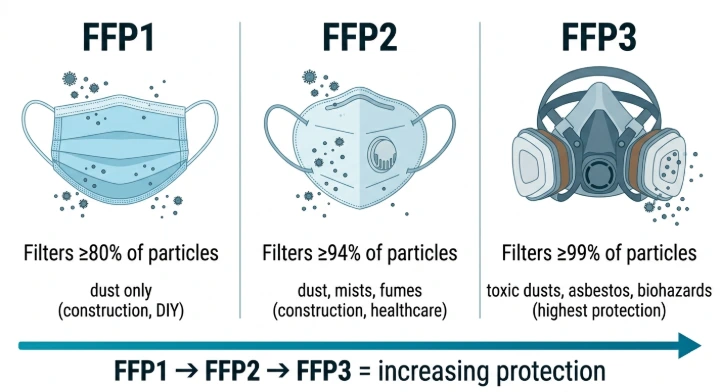
The Three FFP Classes
| Class | Minimum Filtration | Max Inward Leakage | Typical Use |
|---|---|---|---|
| FFP1 | ≥80% | 22% | Non-toxic dust — construction, DIY, sanding, sweeping |
| FFP2 | ≥94% | 8% | Dusts, mists, and fumes — construction, healthcare (flu protection), silica dust |
| FFP3 | ≥99% | 2% | Toxic dusts, asbestos, biohazards — demolition, hazardous waste, healthcare (TB, COVID) |
The filtration percentage tells you how much particulate the mask stops from getting through. The inward leakage tells you how effective the face seal is — FFP3 is much more tightly sealed than FFP1.
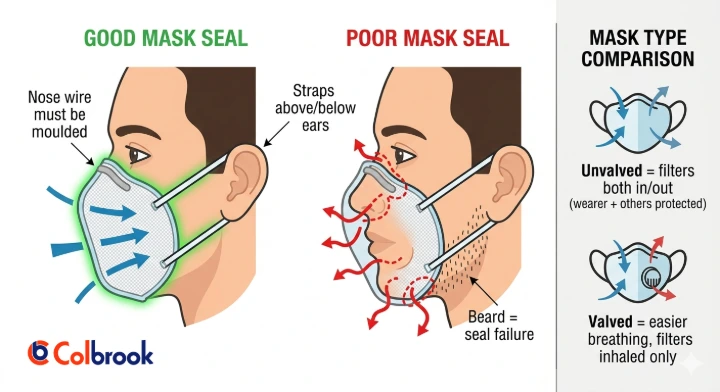
Valved vs Unvalved — What's the Difference?
Unvalved (FFP1, FFP2, FFP3)
Filters both inhalation and exhalation through the same filter material. Protects the wearer and others if the wearer is infected. Standard in healthcare settings. Harder to breathe out through, which means more heat and moisture buildup inside.
Valved (FFP1, FFP2, FFP3 with “V”)
Has an exhalation valve that opens when you breathe out, releasing warm moist air. Easier to breathe in, cooler to wear. But the valve means exhaled air is unfiltered, fine for protecting yourself from the environment, not for protecting others from you.
A mask marked FFP3 V means it's FFP3 rated with a valve. Check if your site requires source control (unvalved) or personal protection only.
Fit Testing Is Not Optional
A mask that doesn't seal is a mask that doesn't work. EN 149 assumes the mask is tested on real faces under the standard, but the actual seal depends on the wearer's face shape, facial hair, and how well they put it on.
Key rules:
- Facial hair breaks the seal. A beard or stubble prevents the mask from sitting flush against the skin. This is not negotiable — if you need tight-fitting RPE, you need to be clean-shaven in the seal area
- Fit testing is a legal requirement under COSHH for tight-fitting RPE (all FFP masks fall into this category)
- Qualitative fit testing (taste test) works for FFP1 and FFP2. Quantitative (particle counting) is needed for FFP3
- Re-fitting — every time you put the mask on, you should do a user seal check (cover the filter surface, exhale sharply, check for leaks)
How Long Do FFP Masks Last?
There's no hard expiry date on EN 149 masks unless the manufacturer specifies one. In practice:
- Disposable FFP masks are single-shift use at most. If they get damp, dirty, or damaged, change them immediately
- Reusable half-masks (EN 140 with EN 149 filters) — the mask body lasts years with proper cleaning. The filter element is replaced when breathing resistance increases or the filter is damaged
- Storage — keep in clean, dry conditions away from chemicals and sunlight. Packaging degrades over years, so rotate stock
Common Mistakes
- Choosing FFP1 because it's cheaper and more comfortable — if the risk assessment says FFP3, FFP1 will not protect them
- Skipping fit testing — a large percentage of workers will fail on the first mask type they try. Multiple models should be available
- Storing masks loose in a toolbox — they pick up dirt, crush, and lose the nose bridge shape
- Letting workers wear the same FFP mask for a week — moisture and contamination build up fast
- Not considering facial hair — site rules must address this clearly
Browse Our Respiratory Protection Range
We stock FFP1, FFP2, and FFP3 masks from Portwest, 3M, and Moldex, plus reusable half-masks and powered respirators. Shop respiratory protection or call +44(0)1236 755544 for guidance on COSHH compliance.
This guide is for informational purposes. Always conduct a full risk assessment under COSHH.
