
If you work in an environment where a single spark could mean disaster, anti-static clothing isn't optional, it's essential. From petrochemical plants to electronics manufacturing, static discharge poses a real risk to both people and products.
The European standard for anti-static clothing is EN 1149. It covers the testing methods and performance requirements for garments designed to dissipate electrostatic charge. Understanding the different parts of the standard helps you choose the right level of protection for your workplace.
What is EN 1149?
EN 1149 is a multi-part standard that specifies how anti-static clothing should be tested and what it needs to achieve. It isn't a single yes/no pass. Different parts test different properties of the fabric and the finished garment.
The standard has five parts, but the ones you'll encounter most are Part 1, Part 3, and Part 5.
EN 1149-1: Surface Resistivity
This part tests the fabric's surface resistance. A fabric sample is placed between two electrodes, and the resistance across its surface is measured. To pass, the surface resistivity must be less than 2.5 × 10⁹ ohms.
Think of surface resistivity as how easily a charge can spread across the fabric. Lower resistance means the charge dissipates faster. If the charge can't spread, it stays localised and builds up until it discharges in a spark.
You'll see EN 1149-1 quoted on many garments, but on its own it only tests the fabric. The way the garment is constructed also matters.
EN 1149-3: Charge Decay
This is arguably the most useful part of the standard. It measures how quickly a charge dissipates from the fabric. A sample is charged to a known voltage, and the time taken for the charge to decay by 50%, the half-life, is measured. To pass, the half-life must be less than 4 seconds. The faster the decay, the better the protection.
EN 1149-3 is the most relevant test for real-world performance. A garment that passes Part 1 but fails Part 3 could still hold a dangerous charge. Always look for both.
EN 1149-5: Performance Requirements for Garments
This is the system-level standard. It brings together the fabric tests and specifies what a complete garment must achieve.
EN 1149-5 requires that:
- The fabric passes either Part 1 (surface resistivity) or Part 3 (charge decay)
- The finished garment has vertical resistance below 2.5 × 10⁹ ohms
- The garment covers the torso and any exposed conductive parts
- All components — including zips, buttons, and labels — are ESD-compatible
When you see a garment labelled as EN 1149-5, it means the whole system has been tested, not just the fabric. This is the certification to look for.
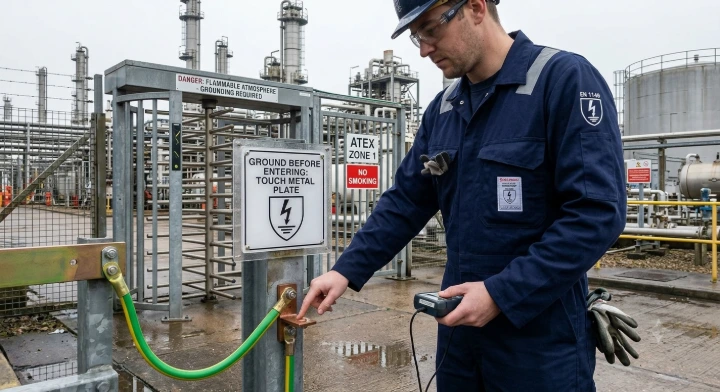
Where is anti-static clothing required?
Anti-static clothing is required in several environments under UK health and safety regulations:
- Petrochemical and chemical processing — flammable gases, vapours, and liquids
- Oil and gas facilities — refineries, storage depots, offshore platforms
- Pharmaceutical manufacturing — flammable solvents and powders
- Electronics assembly — static-sensitive components
- Paint spray booths — flammable solvent vapours
- Grain handling and flour mills — combustible dust
- Munitions and explosives handling
The Control of Substances Hazardous to Health (COSHH) Regulations and the Dangerous Substances and Explosive Atmospheres Regulations (DSEAR) both require employers to control ignition sources. Anti-static clothing is often a key part of that control.
How anti-static clothing works
Anti-static garments achieve their properties in one of two ways.
Conductive fibres — carbon or metal fibres are woven into the fabric, usually as a grid or stripe pattern. These fibres provide a path for charge to travel through the garment and dissipate to earth through conductive footwear and flooring.
Anti-static finishes — chemical treatments applied to the fabric that attract moisture from the air, creating a conductive layer on the fibre surface. These finishes are less durable than conductive fibres and can wash out over time.
For long-term reliability, conductive fibre garments are the better choice. The anti-static properties don't fade with washing, and the grid pattern is easy to verify visually.

What to wear with anti-static clothing
Anti-static clothing doesn't work in isolation. For the system to function properly, you need:
- Anti-static footwear — EN ISO 20345 rated with anti-static properties, providing a conductive path from your body to the floor
- Anti-static flooring or conductive ESD mats to complete the path to earth
- No insulating layers — wool, silk, and synthetic knitwear can generate and hold charge. If worn under anti-static clothing, they defeat its purpose
- No metal accessories — exposed metal zips, buttons, or tools can act as discharge points
The whole system needs to work together. Anti-static clothing with ordinary trainers on an insulating floor won't protect you.
Care and maintenance
Anti-static clothing needs specific care to maintain its properties:
- Wash separately from non-anti-static garments to avoid lint contamination
- Don't use fabric softener — it coats the conductive fibres and reduces effectiveness
- Air-dry where possible. High heat can damage conductive fibres
- Test regularly with a resistance meter. Garments that exceed 2.5 × 10⁹ ohms should be replaced
- Keep test records as part of your PPE inspection schedule
Most anti-static fabrics last 50 to 100 industrial washes before performance degrades. Keep a log of how many washes each garment has been through and replace them on a schedule.
Do you need anti-static clothing?
If your risk assessment identifies flammable gases, vapours, liquids, or combustible dust, the answer is probably yes. DSEAR requires you to eliminate or control ignition sources, and static discharge is one of the most common ignition sources in industrial environments.
At Colbrook, we stock a full range of EN 1149 rated clothing — from anti-static polo shirts and trousers to full coveralls and hi-vis options. Every garment is tested to the relevant parts of the standard and carries clear labelling so you know exactly what you're getting.
Browse our full range of anti-static workwear or call us on +44(0)1236 755544 for advice on the right garments for your workplace.
REF: EN-1149-ANTI-STATIC
